

Master the Basics
Anchoring Your Sea Ray Boat
The information provided is for general informational purposes only. This information is based on the author’s personal experience and does not constitute financial or legal advice. You should consult with a professional and/or conduct your own independent research to verify any information in this post prior to making a financial decision or otherwise.
To inexperienced boaters, anchoring can seem like a no-brainer – you drop the anchor and nature does the rest. However, properly anchoring a boat is much more than that. It allows you to go for a swim or spend time offshore, and it could save your boat from drifting in the unlikely event of an emergency. To get the most out of your time on the water and protect your Sea Ray, it’s important that you master how to safely anchor your boat.
Anchors
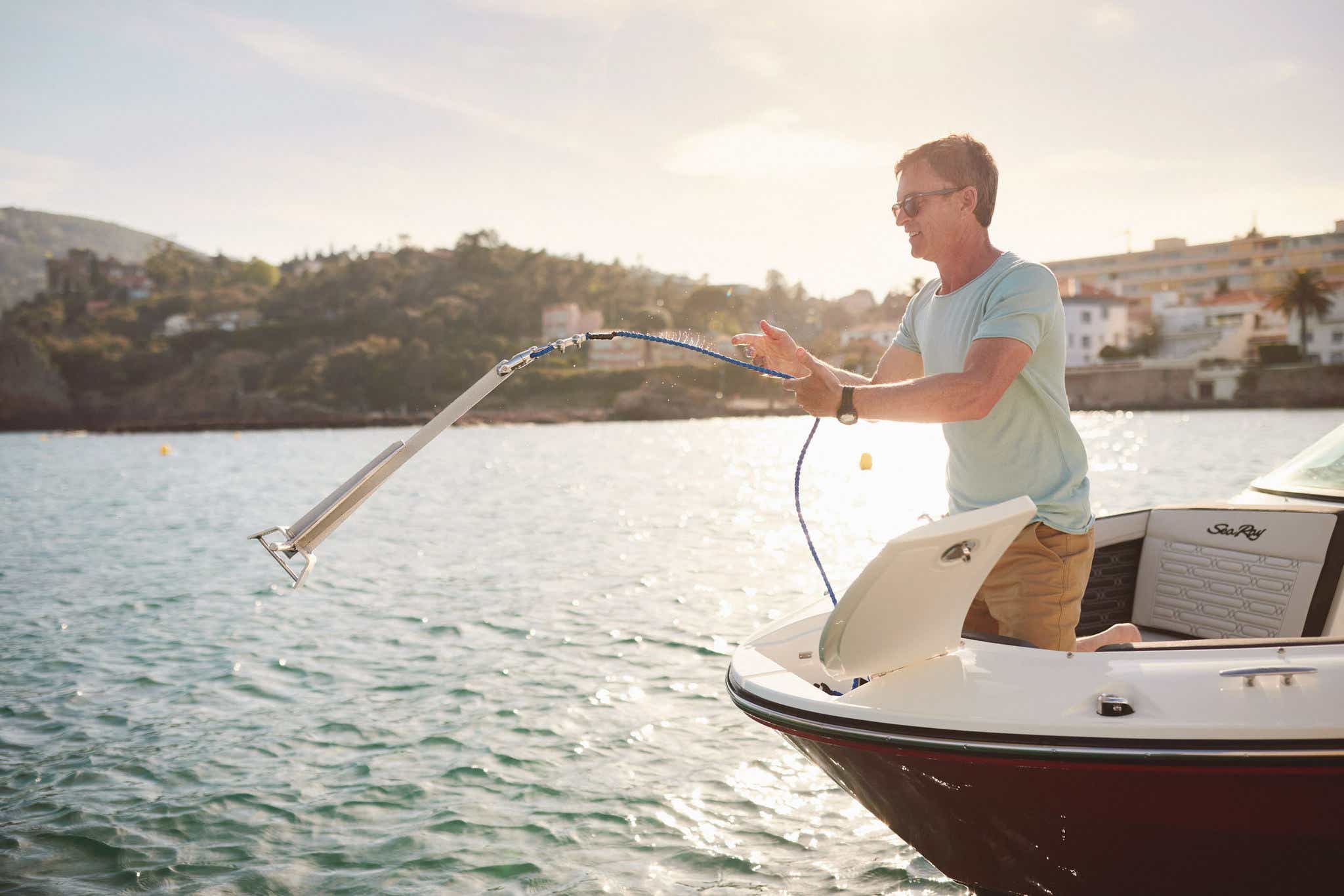
Did you know the earliest anchors were rocks? Today, the two most common types of anchors for recreational boats are the fluke anchor and plow anchor. Larger boats like models in our Sundancer and SLX families are equipped with plow anchors. For smaller boats like the SDX 250, the SDX 250 Outboard and models in our SPX lines, we recommend fluke anchors.
Fluke Anchor
Made to accommodate small to medium boats, the fluke anchor is lightweight and easy to handle. It folds flat and is easy to store. The fluke anchor is best suited for sandy or muddy bottoms. If you own an SDX 250, SDX 250 Outboard or SPX, you can store your fluke anchor in your boat’s anchor storage locker.
Plow Anchor
Built to secure heavier boats, the plow anchor is heavier than the fluke and doesn’t fold. It holds well in most bottom conditions and usually resets itself if the wind shifts. If you own a boat like a Sundancer or SLX with a windlass, you can use it to easily hoist your plow anchor.
The plow anchor is connected to the boat with the rode, which depending on your Sea Ray’s anchor, typically includes a length of chain at the anchor end and a nylon line from the chain to the boat.
How To Anchor Your Sea Ray Boat
Follow these simple steps to anchor your Sea Ray on inland or coastal waters. If you’re new to anchoring, we recommend practicing where there’s plenty of room around your boat. Once you understand the planning and calculations, you’ll be able to confidently anchor your boat like the true captain you are.
- Determine the water depth using your boat’s depth finder. Most Sea Ray boats are equipped with a depth gauge.
- Once you know the depth, calculate a scope ratio of 7:1 (seven feet of scope per one foot of depth). Scope is the ratio of the length of the anchor line you’ll release to the depth of the water. Depending on your boat, you’ll also want to add a few feet to your calculation to account for the distance from the water to your boat’s tie-off point.
- Motor into the wind or current for the length of your calculation. For example, if the water is 10 feet deep and your boat’s tie-off point is five feet from the water, you’ll need a scope of 70 feet plus five feet. You’ll motor 75 feet into the wind or current past where you want to anchor
- Lower your anchor and let out enough line for your calculation, allowing the wind or current to carry you back. If there’s not enough wind or current, use the motor.
- Secure the anchor line to a bow cleat. Never tie off an anchor to the stern (it could pull the stern down and swamp the boat).
- Apply a little power in reverse to set your anchor in the bottom. Use landmarks or your boat’s GPS to make sure the anchor holds and you aren’t dragging anchor.
- Depending on the weather or current, you may need to reset the anchor. Also, the anchor will sometimes reset itself with wind or current changes.
Retrieving Your Anchor
Weather and boating conditions can quickly change, so stay alert while your anchor is down. Follow these steps to easily raise your anchor.
- Motor slowly towards your anchor while pulling in the rode.
- Once you’re directly over it, the anchor should pull free.
If your anchor is stuck, try releasing it with these techniques.
- Using the motor, slowly turn your boat in a large circle to change the direction of pull on the line.
- Turn the line around a bow cleat.
- Pull the line taut as the bow of your boat dips in the bottom of a wave. When the next wave lifts your boat, the anchor may pull free.
- If you can’t release your stuck anchor, you may need to cut the line as a last resort and replace the anchor.
Anchors aweigh! Now that you know more about anchoring, you’re ready for an adventure out on the waves in your Sea Ray boat.
This website does not provide financial or legal advice. The information available on this website is provided for general informational and educational purposes only and is not a substitute for professional advice. You should consult with the appropriate professionals prior to making any financial decisions. YOUR USE OR RELIANCE ON ANY OF THE INFORMATION PROVIDED HEREIN IS SOLELY AT YOUR OWN RISK. UNDER NO CIRCUMSTANCE SHALL WE HAVE ANY LIABILITY TO YOU FOR ANY LOSS OR DAMAGE OF ANY KIND INCURRED AS A RESULT OF THE USE OR RELIANCE ON ANY INFORMATION PROVIDED.
Options and features mentioned subject to change. Please confirm availability of all accessories and equipment with an authorized Sea Ray dealer.