

Why to Consider
The Beginner and Solo Boater Guide to Stress-Free Docking
The information provided is for general informational purposes only. This information is based on the author’s personal experience and does not constitute financial or legal advice. You should consult with a professional and/or conduct your own independent research to verify any information in this post prior to making a financial decision or otherwise.
Docking confidence starts before you enter the marina. The most manageable boats for a newer or solo operator combine a low-windage profile, clear visibility from the helm and a propulsion package that can control both ends of the boat at once. Add joystick piloting and GPS-based station keeping where available, and close-quarters maneuvers become more deliberate—even when wind or current starts to move the boat off your intended line.
That does not make docking automatic. Momentum, windage and available thrust still set the limits. But the right hull proportions and helm systems can reduce the number of inputs you need to manage at the same moment, leaving more attention for the slip, the dock and the people aboard.
For boats in the 19- to 40-foot range, the buying decision is less about choosing the largest engine and more about choosing a complete low-speed-control package. Your view from the helm, the boat’s exposed profile, independent engine control and the ability to hold heading or position all deserve a place in the decision.
Wide Beams, Low Windage, and Clear Sightlines Create the Most Forgiving Docking Platform
The most forgiving boats for beginner drivers in tight marinas combine a low-windage profile, a stable beam, unobstructed 360-degree helm sightlines, and responsive low-speed propulsion. Horsepower matters underway, but at idle speed in a crowded fairway, the decisive factors are how much lateral wind surface the hull presents and what you can see from the helm seat.
Beam can contribute to the boat’s onboard stability and usable cockpit space, but width alone does not determine how easy a boat will be to dock. A wider hull also occupies more room in a fairway and slip. The more useful question is whether the boat’s dimensions, helm position and windage suit the marinas where you expect to keep it.
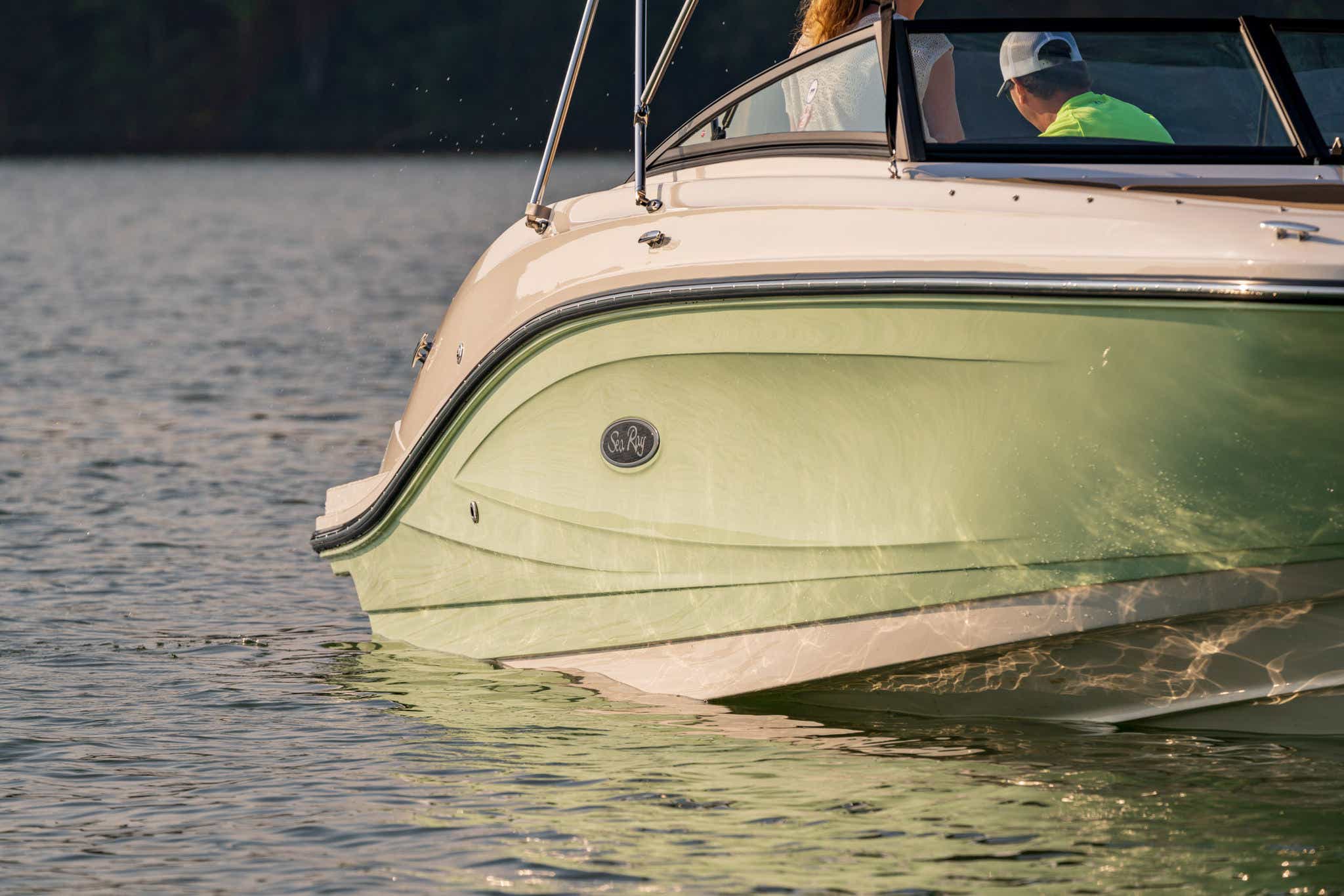
Freeboard deserves special attention. Taller topsides create more surface for a crosswind to push against, while a lower profile reduces that wind exposure. Recreational docking guidance from Captain Tyler Ryan similarly connects higher freeboard with greater windage and more difficult maneuvering. The point is practical: when you pull back to idle in a narrow fairway, a gust can begin moving the boat before you have time to settle into the approach.
Visibility changes how early you notice that movement. In its discussion of recreational powerboats from 26 to 40 feet, Boating Magazine notes that lower-windage profiles and clear sightlines improve handling confidence in close quarters. From your helm seat, look past the windshield, around the console and toward the stern quarter. Can you see the slip entrance and dock edge without repeatedly changing position? Can a passenger on the cockpit side communicate with you without blocking your view?
During a dealer visit, sit at the helm with the canvas, enclosure or sunshade configuration you would actually use. Check the view toward the bow, both quarters and the swim platform. Then consider the boat’s exposed height against the wind conditions at your marina, rather than treating overall length as the entire docking story.
A lower profile cannot cancel a strong crosswind, and clear sightlines do not replace practice. They give you more time to recognize what the boat is doing, which is often the difference between a composed correction and a rushed one.
Joystick Piloting Delivers Direct Vector Authority That Standalone Bow Thrusters Cannot Match
For a nervous solo operator, an integrated joystick piloting system provides far more control and confidence than a standalone bow thruster. A bow thruster can be useful for moving the front of a boat, particularly when the bow begins to blow away from the dock. But a solo driver is still managing the stern, throttle, steering and forward or reverse gear. In a gust, that division of work matters.
Integrated multi-engine joystick systems coordinate the engines and drives to produce movement that separate helm inputs would otherwise require. Mercury’s Joystick Piloting documentation describes multi-axis control that can crab sideways and rotate a boat through integrated engine and drive control. That capability is especially relevant when the stern needs to move with the bow rather than follow it after several separate corrections.
The essential difference for a solo operator is scope: a bow thruster addresses one end of the boat, while integrated joystick piloting coordinates the entire platform. Mercury describes its joystick system as managing engine position, rpm and gear selection while allowing lateral motion and rotation from one hand. That leaves your other hand free to communicate, manage a line when appropriate or steady yourself at the helm.
There is a tradeoff. A joystick package introduces more equipment to understand and service than a standalone thruster. It also has physical limits. In severe wind or current, the system may not have enough thrust to create the movement you ask of it. Treat the joystick as a precise control interface, not a reason to enter conditions beyond your experience or the boat’s ability to hold position.
For a sea trial, ask the dealer to demonstrate how the selected propulsion configuration moves laterally, rotates and responds when the boat is held briefly in a crosswind. Then take the joystick yourself. The important measure is not how impressive the maneuver looks from the dock; it is whether the helm inputs make sense to you when the stern starts to drift.
Digital Station Keeping and Auto Heading Hold Your Position While Securing Dock Lines
For new boaters and solo operators, combining auto heading with digital station keeping creates an essential pause button during close-quarters maneuvers and docking approaches. The hardest part of solo docking can arrive after the approach appears complete. You have the boat near the dock, but you still need to prepare fenders or secure the first line while wind and current continue working on the hull.
GPS-based station keeping is designed for that holding moment. In a sea trial of a 31-foot recreational powerboat, YachtBuyer described digital station keeping such as Skyhook as holding position and heading so a solo operator could hang fenders and secure lines without the boat drifting away. Mercury describes Joystick Piloting and Skyhook digital anchoring as using GPS precision to hold a boat’s position and heading against wind and current.
For a solo owner, that can change the rhythm at the stern and cockpit. Rather than rushing from the helm because the boat is already beginning to slide, you have a temporary holding tool while you prepare for the dock. It can also give a less experienced family member more confidence at the helm while another person handles lines.
Station keeping is not an unattended docking mode. GPS position holding has finite thrust available, and wind, current, traffic, dock geometry and water depth still matter. You need to remain at the helm or close enough to resume control immediately, and you still need to understand how the boat responds when power is applied or released.
Ask exactly what is included with the selected propulsion package. “Auto heading,” “heading hold,” “virtual anchor” and “station keeping” are often used casually in marina conversation, but their functions and availability can differ by engine, control system, model year and configuration. Have the dealer identify the installed system by name, explain its intended use and demonstrate how it engages and disengages.
The reassurance comes from having a measured pause when you need one, not from assuming technology can secure the boat for you.
Twin-Engine 30-Foot Cruisers with Joystick Vectoring Give Every Crew Member Helm Confidence
For couples and families seeking a 30-foot cruiser that a spouse or secondary operator can dock confidently, twin-engine sport cruisers equipped with integrated joystick piloting and digital anchoring deliver exceptional low-speed control. A 30-foot cabin cruiser brings more boat to manage in a marina, but it also creates an opportunity to choose a propulsion package designed around controlled low-speed handling rather than a conventional twin-engine setup that requires separate throttle, shift and steering corrections.
Sea Ray sport cruisers equipped with twin sterndrive or outboard joystick piloting systems offer fingertip piloting to counter difficult docking variables such as wind and current. The practical payoff is simple: a secondary operator or spouse can focus on where the boat needs to move rather than trying to coordinate multiple controls under pressure.
The Sundancer® line combines day-boating features with overnight accommodations, so the decision should include how the boat works from bow to stern as well as how it feels at the dock. On a cruiser, the helm is only one working zone. The cockpit needs a clear route for a person carrying lines or fenders, the side decks and dock-side access need to suit your marina routine, and the stern area needs to support the way your crew boards and secures the boat.
On the Sundancer 320, standard Joystick Propulsion provides independent engine maneuvering designed to give captains at different experience levels greater control in tight marinas and changing conditions. That does not mean every Sundancer or Sea Ray model has the same system. Features, propulsion choices and availability vary by model and configuration, so confirm the equipment on the exact boat you are considering with an authorized Sea Ray dealer.
A heavier cruiser does not become immune to wind simply because it has more mass. Windage, momentum and the distance between the helm and the dock still shape every arrival. The advantage of twin-engine joystick control is that it gives the operator a more direct way to counter those forces without asking a spouse or guest to take on tasks they are not yet comfortable performing.
That makes more days aboard feel shared. A partner who can hold position, rotate into a slip or keep the boat steady while you handle a line is more likely to take the helm when the marina is busy—and more likely to enjoy the time that follows.
What to Verify Before You Buy
The purpose of helm assistance technology is to give you calmer, more precise control when the space around the boat gets tight. Choose the hull profile, sightlines and propulsion package that let you make deliberate inputs from the helm, then verify those systems on the water before you decide.
Use this assessment during the dealer conversation and sea trial:
Assess windage from the actual helm. Sit in the helm seat and check your view toward the bow, each quarter, the dock-side cockpit and the stern. Ask how the boat’s freeboard and enclosure configuration affect visibility and crosswind behavior at idle.
Confirm the propulsion layout. Determine whether the boat has a single engine, twin engines, a bow thruster, integrated joystick control or a combination of systems. For solo docking, ask which controls move the stern as well as the bow.
Test joystick response yourself. In open water and in an appropriate protected area, ask the dealer to supervise while you move the boat sideways, rotate it and make small corrections. Pay attention to the relationship between your hand movement and the boat’s response.
Identify the station-keeping function. Confirm whether a GPS-based holding system is installed on the exact configuration, what position and heading functions it provides, and how to take control again immediately.
Practice a representative marina approach. Choose conditions that resemble your intended use where possible. A calm-water demonstration can confirm control logic, but it cannot predict every crosswind or current you will encounter.
Plan for the crew you have. Walk through who will stay at the helm, who will handle fenders and who will secure the first line. Technology can reduce the number of simultaneous helm tasks, but it does not remove the need for clear roles and attentive operation.
The right boat should let you approach the dock with a plan rather than a scramble. When you can see clearly from the helm, control both ends of the boat and hold position long enough to prepare for the next step, the marina becomes part of the day on the water—not the reason to cut it short.
This website does not provide financial or legal advice. The information available on this website is provided for general informational and educational purposes only and is not a substitute for professional advice. You should consult with the appropriate professionals prior to making any financial decisions. YOUR USE OR RELIANCE ON ANY OF THE INFORMATION PROVIDED HEREIN IS SOLELY AT YOUR OWN RISK. UNDER NO CIRCUMSTANCE SHALL WE HAVE ANY LIABILITY TO YOU FOR ANY LOSS OR DAMAGE OF ANY KIND INCURRED AS A RESULT OF THE USE OR RELIANCE ON ANY INFORMATION PROVIDED.
Options and features mentioned subject to change. Please confirm availability of all accessories and equipment with an authorized Sea Ray dealer.