

Why to Consider
Pontoon vs. Fiberglass Deck Boats: Choosing the Right Hull for Space, Chop, and Entertaining
The information provided is for general informational purposes only. This information is based on the author’s personal experience and does not constitute financial or legal advice. You should consult with a professional and/or conduct your own independent research to verify any information in this post prior to making a financial decision or otherwise.
For a calm-water host who measures a great day by how many people can settle into a cove, a pontoon or tritoon can be the natural answer. Its flat, rectangular deck gives guests room to spread out, move from lounge to lounge and board easily at a sandbar.
For an active lake family, the answer often shifts toward a wide-bow fiberglass deck boat. Carrying guests, towing a tube and crossing an afternoon lake after traffic has built are different demands from floating at anchor. A fiberglass deck boat gives up some edge-to-edge floor area, but it brings a sculpted V-hull beneath a broad social layout. That distinction shapes the entire day aboard.
The right choice is less about whether one category is universally better. It is about where you spend your time, how many people you carry and whether your guests will still be comfortable once the water stops behaving like a protected cove.
Deck boats deliver pontoon-style deck width without sacrificing fiberglass ride dynamics
A pontoon uses a broad, largely rectangular platform over its tubes, which is why it can feel so open at rest. That architecture makes sense for families who want perimeter seating, easy circulation and a generous footprint for floating, swimming and sharing lunch at anchor. Pontoons and tritoons are designed to maximize usable deck area and passenger weight capacity across the platform, according to VIF Propeller.
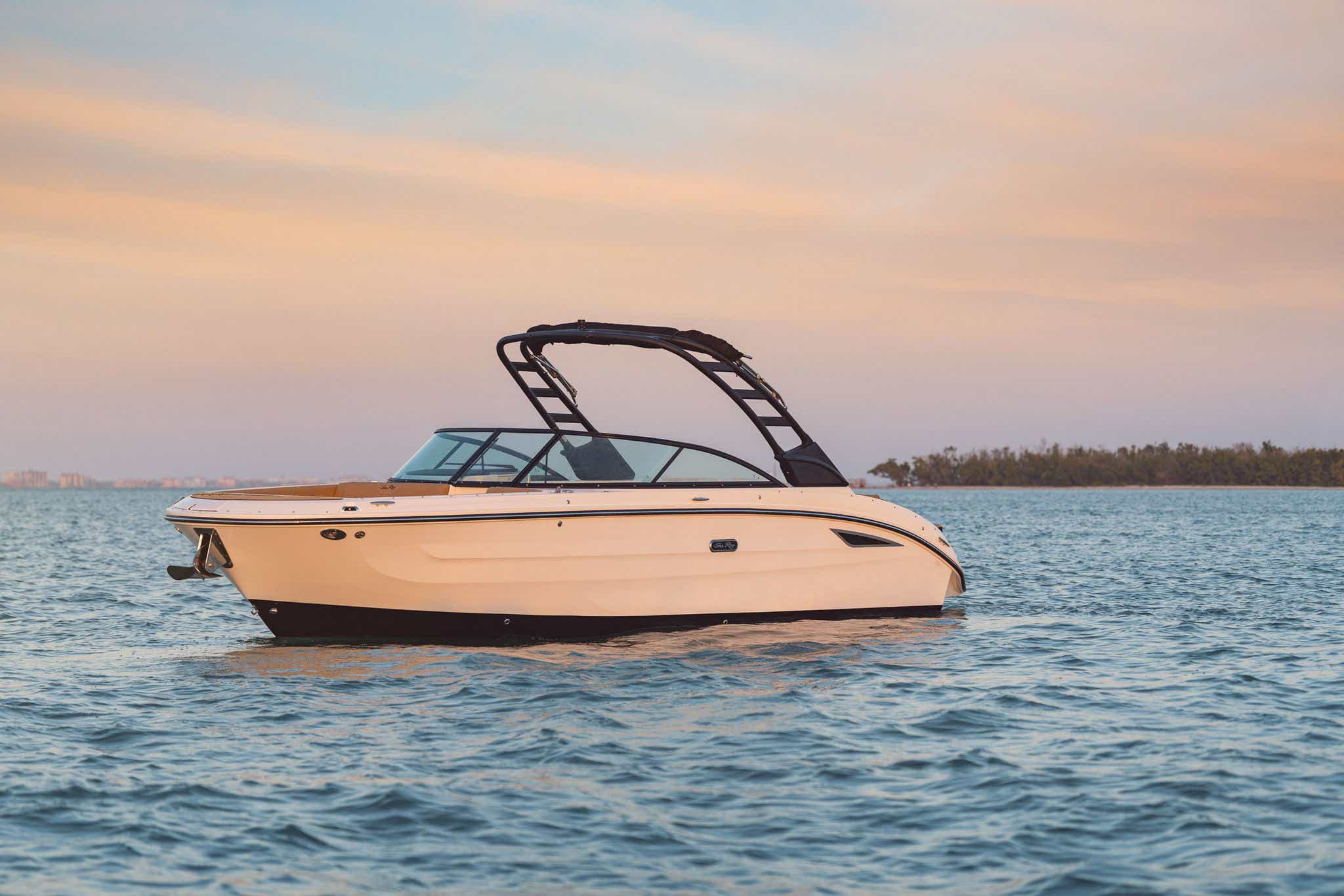
A fiberglass deck boat approaches space differently. Rather than leaving the bow narrow like a traditional bowrider, it carries beam forward, making the front lounge a usable social zone rather than a pair of occasional seats. Boating Magazine describes wide-bow deck boats as designs that bring beam into the bow for more seating space while retaining modified-V or progressive-V hull profiles underneath.
That is the bridge an active family is often looking for. You can have grandparents settled into the bow lounge, children moving between the cockpit and swim platform, and an operator who still has a hull intended to turn and run with more precision than a flat platform.
A practical hull decision for a $100,000–$160,000+ search
The category matters more than a single advertised feature. Use the matrix below to decide which compromise fits your water and hosting style, then compare exact models, engine packages and capacity labels with a dealer.
A toddler’s sandbar day is a useful test case. If beaching, easy adult supervision and a broad, low-stress gathering space define the day, a pontoon’s open floor plan deserves serious weight. If that same outing regularly becomes a longer cruise across exposed water, the deck boat’s bow seating and V-hull may be the better fit. Walk the boarding route with the child in mind: where towels, snacks, life jackets and wet feet will actually go matters as much as the seating count.
Traditional bowriders still have a place here. A family of six that spends more time tubing, cruising and running between destinations than hosting a dozen people may prefer their more focused, sport-boat layout. But for three generations and a larger guest list, a deck boat’s forward beam can relieve the familiar pressure of asking everyone to fit into a narrow bow.
Fiberglass V-hulls maintain control and passenger comfort when afternoon lake chop picks up
The lake you leave in the morning is not always the lake you cross in the afternoon. Boat wakes, wind and traffic can turn open water into irregular chop, and hull geometry becomes more than an abstract design choice.
V-shaped fiberglass hulls are designed to cut through choppy water and boat wakes, while pontoons ride on top of the water. Ride depends on the specific hull, load, speed, trim, operator and water conditions. But it does explain why a buyer whose lake routinely turns rough after lunch should prioritize an on-water evaluation over a showroom impression.
A high-horsepower tritoon may be a meaningful step up from a two-tube pontoon for buyers who want more capability without leaving the category. Yet the fundamental running behavior remains different from a V-hull. You feel that difference when turning across wake lines, tracking a towable and bringing a full crew home through uneven water.
For watersports buyers, horsepower should not be treated as a headline number. The useful question is whether the selected engine package, passenger load and intended use work together. A boat that feels lively with four people aboard may behave very differently with twelve adults, coolers and tow gear. Your sea trial should include representative weight, not an empty boat and flat water.
High-capacity lake hosting requires deep storage, secure gunnels, and matched engine displacement
Hosting 10 to 14 people changes the boat’s job. The question is no longer simply how many bodies fit on the upholstery. It is whether everyone can move safely, stow gear and remain settled as the boat transitions from idling in a cove to cruising across the lake.
VIF Propeller notes that heavy passenger loads affect running trim and call for buoyancy, matched horsepower and proper weight distribution. Boating Magazine likewise identifies deep cockpit freeboard, appropriate horsepower and integrated amenities as important considerations for day boats carrying 10 to 14 passengers.
Start at the helm and work aft. Can the operator maintain a clear sightline when guests are seated? Is there a defined route from the bow lounge to the cockpit and swim platform, or does every towel bag and inflatable end up in the walkway? Are there secure places for children and older guests to sit when the water gets unsettled?
Storage becomes part of ride comfort because loose gear changes how people occupy the boat. Skis, tow ropes, inflatable tubes, food bags and extra life jackets need a home below seats, beneath the deck or in dedicated lockers on the exact boat you are considering. A clear cockpit lets guests hold a secure seat rather than stepping around equipment as the hull responds to wake.
Capacity labels also deserve a more careful reading than a single maximum number. Treat the rating as a limit, not an ideal operating plan for every water condition. A full crew affects trim, acceleration and the boat’s ability to plane, so ask to see the capacity label and discuss the intended passenger load with an authorized dealer. For a 10- to 14-person day, match power to the exact model, configuration, gear load and conditions you expect to encounter.
That conversation is especially important in this price range. Rather than assuming that a larger engine automatically solves a full-boat problem, assess the entire package: hull, seating plan, freeboard, storage, propulsion and the way your group actually spends a Saturday.
Deck boat or bowrider for lake parties?
For parties, a wide-bow deck boat generally makes better use of its forward section than a traditional bowrider. The bow becomes a genuine lounge, and the cockpit can remain available for conversation, food and movement toward the swim platform. That architecture makes sense when hosting is a primary use rather than an occasional extra.
A traditional bowrider can still be the right fiberglass choice for a smaller crew that values a sportier layout and spends more of the day underway. The tradeoff is straightforward: its narrower bow usually asks more of the cockpit, while a deck boat distributes social space farther forward.
Within our lineup, the SDX Series is the relevant category to inspect when you want a fiberglass deck boat with a broad social layout. The SDX Series offers premium fiberglass boats from 23 to 29 feet with outboard, sterndrive and surf propulsion options, but features, capacity and equipment vary by model and configuration. Confirm the details of the boat in front of you rather than assuming one layout or engine package applies across the series.
Choose for the water you actually cross
A pontoon or tritoon remains a strong choice when protected coves, sandbars and maximum flat-deck gathering space define your boating. It gives a large group an easy place to relax, particularly when the ride home is short and calm.
Choose a wide-bow fiberglass deck boat when your crew wants room to host without treating driving comfort, turning response and tow-sport use as secondary concerns. It will not duplicate every inch of a pontoon’s rectangular deck, but it can make the run between destinations feel more composed while still giving guests a place to settle in.
Before selecting either, arrange an on-water demonstration in the conditions your family actually encounters. Bring the people who will use the bow lounge, cockpit and swim platform. Sit in each zone, open the storage, walk the boarding path and run the boat with a realistic passenger load. The right hull is the one that lets your guests enjoy both the destination and the ride there.
This website does not provide financial or legal advice. The information available on this website is provided for general informational and educational purposes only and is not a substitute for professional advice. You should consult with the appropriate professionals prior to making any financial decisions. YOUR USE OR RELIANCE ON ANY OF THE INFORMATION PROVIDED HEREIN IS SOLELY AT YOUR OWN RISK. UNDER NO CIRCUMSTANCE SHALL WE HAVE ANY LIABILITY TO YOU FOR ANY LOSS OR DAMAGE OF ANY KIND INCURRED AS A RESULT OF THE USE OR RELIANCE ON ANY INFORMATION PROVIDED.
Options and features mentioned subject to change. Please confirm availability of all accessories and equipment with an authorized Sea Ray dealer.