

Why to Consider
Powerboat Hull Performance Guide: Balancing Weight, Planing Dynamics, Ride Quality, and Fuel Economy
The information provided is for general informational purposes only. This information is based on the author’s personal experience and does not constitute financial or legal advice. You should consult with a professional and/or conduct your own independent research to verify any information in this post prior to making a financial decision or otherwise.
A 26-foot boat can feel perfectly matched on a quiet morning with two people aboard, then become a very different boat with a full fuel tank, eight adults and an afternoon breeze. The length has not changed. The conditions that determine its running attitude have.
For 24- to 28-foot bowriders, deck boats and cabin cruisers, the useful buying question is not simply “How much horsepower does it have?” It is whether the hull shape, displacement, propulsion package and passenger load work together in the conditions you actually expect to run.
A lighter, flatter hull may respond quickly and post appealing flat-water numbers. A heavier hull with a deeper V can bring a more composed feel through chop, though it asks more from the engine and fuel tank. Neither approach is universally right. The right choice begins with an honest account of your water, your usual crew and the days when the boat will be carrying its fullest load.
Hull Deadrise, Weight, and Power Determine the Fundamental Trilemma Between Ride Comfort, Acceleration, and Cruising Range
Deadrise is the angle of the hull bottom at the transom. A flatter bottom presents more surface to the water, which can create dynamic lift more readily as speed builds. A deeper-V hull meets waves with a sharper entry and spreads impact over a longer moment, helping soften the motion felt at the helm and in the cockpit.
That comfort has a physical cost. As Capt. Eric Sorensen explains in his discussion of deadrise, higher transom deadrise can absorb wave impact more gradually, but it also gives up dynamic lift, speed, propulsion efficiency and some stability. The hull must move more water before it can settle into an efficient planing attitude.
Weight compounds the equation. A heavier fiberglass boat carries more mass through a wave pattern and can feel less abrupt in chop, but it also needs more thrust to accelerate and climb onto plane. Add a deeper running surface, passengers, gear and fuel, and the engine has more resistance to overcome during the most demanding part of the run.
This is why static specifications do not tell the whole story. Two boats of similar length may have very different behavior because their beam, deadrise, dry weight, fuel capacity, seating layout and power package differ. A deck boat designed around wide social space and a cabin cruiser carrying overnight accommodations should not be judged by the same expectation for hole shot or cruise economy.
For a boat that spends its life on protected water with a light crew, early planing and a lower-speed cruise may carry real value. For a boat that regularly meets afternoon chop, the deeper-V tradeoff can be worthwhile because it lets your crew remain more comfortable at a practical cruising speed. The decision is about usable days on the water, not a single top-speed number.
Miles Per Gallon Governs Cruising Range While Gallons Per Hour Dictates Throttle Management
At the helm, gallons per hour tells you how quickly fuel is leaving the tank. Miles per gallon tells you how effectively that fuel is moving the boat down the water. You need both, but they answer different questions.
A boat running below its planing threshold may show a modest GPH number while pushing a large bow wave and covering little distance. Passagemaker Magazine’s analysis of fuel burn by operating regime makes the central point clearly: a lower hourly fuel flow does not automatically mean better fuel economy.
Consider this illustrative 26-foot sterndrive example. The values are representative operating figures, not test results for a specific model.
The 3,800-rpm setting burns more fuel per hour than the 3,000-rpm setting, yet it travels substantially farther on each gallon because the hull is carrying itself efficiently. Wide-open throttle adds speed, but the additional fuel flow pulls economy back down.
Your best cruise point will vary with hull form, sea state, trim, propeller, passenger load and engine package. Watch speed and fuel flow together, then calculate MPG or nautical miles per gallon over several runs. The useful range is usually where the boat is clearly on plane, the bow is settled, steering feels natural and speed increases proportionately with throttle input.
Heavier Hulls and Deeper V-Sections Trade Fuel Use for Rough-Water Composure
The deeper-V question is often framed as a choice between comfort and cost. It is more useful to think of it as a choice between different kinds of operating flexibility.
BoatTEST notes that deeper-V hulls cut through waves more effectively and can deliver a softer ride, while their greater wetted surface creates additional friction. In practical terms, a deeper running surface may let you maintain a composed pace in chop that would make a flatter hull uncomfortable at the same speed. The fuel penalty is real, but so is the difference between a day limited by water conditions and a day your guests can still enjoy.
There is no universal percentage penalty that applies across all 26-foot boats. Propulsion, load, bottom design, trim and water conditions can change the result considerably. A buyer considering transom deadrise in roughly the high-teens to low-20-degree range should compare tested fuel data at equivalent speeds and loads, rather than comparing one boat’s best-MPG figure with another boat’s top-speed run.
The heavier, deeper-V option makes particular sense when rougher water is a regular part of the plan. It is less compelling when the boat will primarily carry a small crew on calm inland water and range is the priority. Either way, ask for sea-trial conditions that reveal how the hull reacts after the water has developed some texture.
Planing Thresholds Under Heavy Passenger Loads Require Active Trim and Proper Weight Distribution
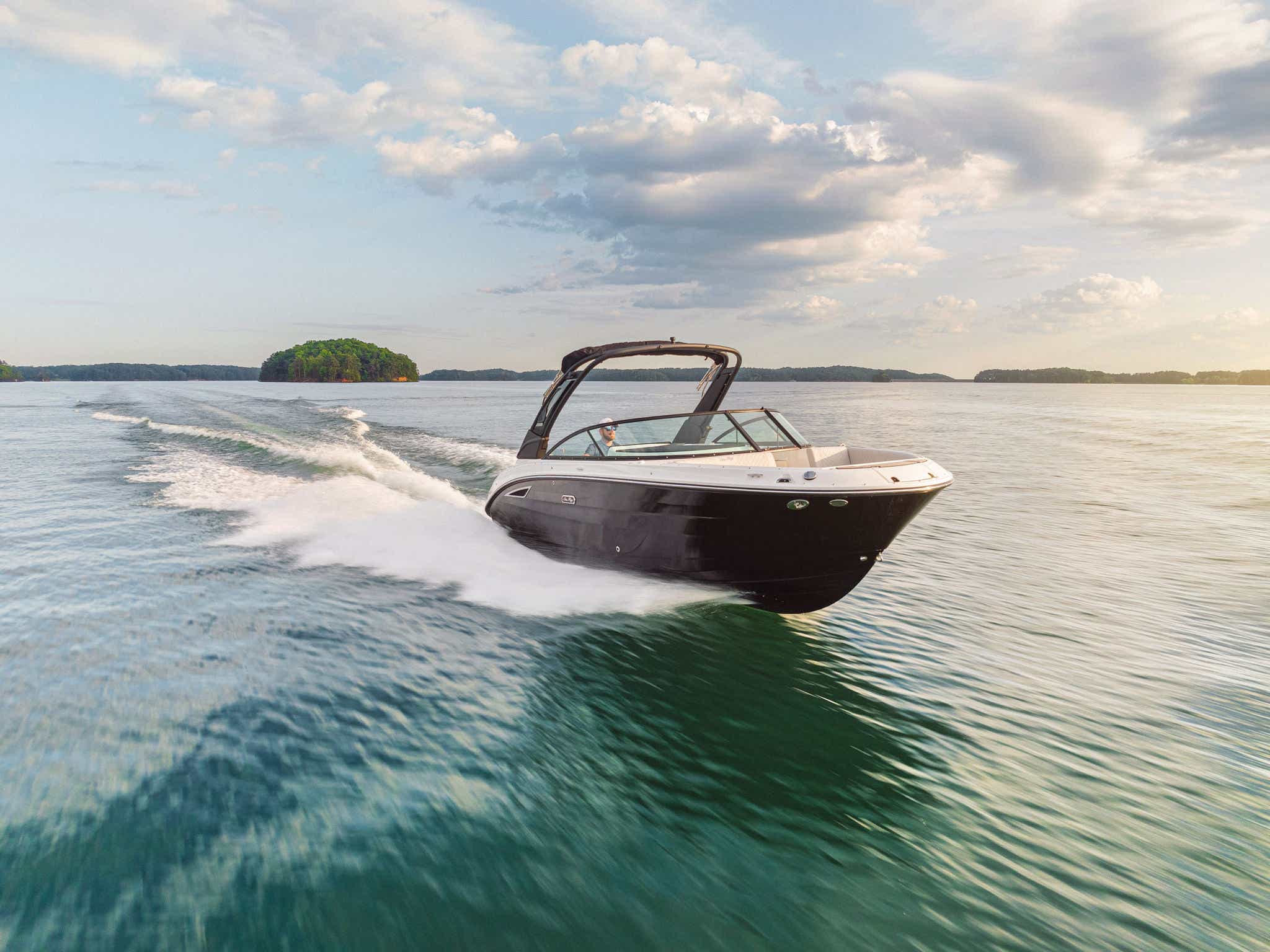
A boat’s hardest moment is often the transition from displacement running to planing. With a light crew, the bow rises briefly, the hull builds lift and the boat settles. With a full aft cockpit, coolers, gear and fuel, that transition can take longer and obscure forward visibility.
The issue is not passenger count alone. It is where the weight sits. Adults concentrated behind the helm shift the center of gravity aft, allowing the stern to settle deeper and increasing bow rise. A single-engine 26-footer carrying eight adults may have a noticeably more demanding hole shot than it does with four people aboard, particularly if the group remains gathered in the aft lounge.
Trim tabs can help correct that attitude. Bennett Marine explains that tabs can lower the bow, improve the running angle and help a heavily loaded boat reach plane more quickly. By creating lift at the stern, the tabs bring the bow down and reduce the period spent pushing through a high-drag bow wave.
Before accelerating, have passengers distribute themselves thoughtfully rather than filling the stern first. Start with tabs deployed enough to assist the hole shot, then bring the boat onto plane with a smooth, deliberate throttle application. Once the hull has settled, retract or adjust tabs gradually while watching speed, engine RPM and ride attitude. Follow the owner’s manual for your specific boat and trim system, and keep passenger movement measured while underway.
Electric trim tabs are part of the configuration on our Sundancer 320, paired with available MerCruiser® 6.2L 300- or 350-hp Bravo Three® sterndrive power. That hardware can help manage running attitude, but no trim system substitutes for selecting a configuration suited to the intended load and conditions.
Variable Crew Loads Demand Sizing Propeller Pitch and Engine Power for Peak Capacity
The occasional full-capacity outing should influence the purchase, even if your normal day is four people aboard. A boat configured only for a lightly loaded cruise may lose its easy planing character once guests, gear and fuel are added.
Propeller selection makes this tradeoff visible. A higher-pitch propeller generally favors speed at a given RPM when the boat is lightly loaded, but it can make it harder for the engine to reach the RPM needed to develop strong acceleration under a heavy load. A propeller chosen for the fastest showroom-style run may not be the one that gives your boat the most relaxed, usable response on a busy summer day.
Soundings Online notes that heavy displacement and excess running resistance can make engines labor during the transition to plane unless the boat is properly trimmed and powered. That does not create a simple horsepower rule. The same rated engine can feel different on two hulls, and elevation, propeller choice, water conditions and load distribution all matter.
Bring your realistic peak-load scenario to an authorized Sea Ray dealer. Specify the passenger count, fuel level, gear, watersports use and water conditions you expect. Then ask to compare the available power and propeller options in that context. Our lineup includes outboard, sterndrive and surf propulsion across 19- to 40-foot premium fiberglass boats, but equipment and availability vary by model and configuration.
A note on twin-engine efficiency
Twins can offer benefits beyond straight-line performance, including propulsion redundancy and docking characteristics, but they do not automatically deliver superior fuel economy. In a Boating Magazine sea trial of a 24-foot center console, a single 300-hp outboard reached up to 3.9 mpg at 3,500 rpm, compared with 2.7 mpg for twin 150-hp outboards on that tested hull. That is one hull and one test configuration, not a rule for every 24- to 26-foot boat.
For a twin-engine day boat, compare fuel economy at the same speed, similar fuel load and similar passenger weight. The engine count tells only part of the story.
What to Test Before Choosing a 28-Foot Cabin Cruiser or Day Boat
A sea trial should reproduce the day that matters, not the lightest possible run. For a cabin cruiser, ask to test with a meaningful fuel load and enough people aboard to approximate your regular guests. For a day boat, include the gear you would actually bring for swimming, entertaining or watersports.
During the trial, pay attention to a few specific moments:
The hole shot: Does the bow rise block your sightline for an extended period? Does the boat settle onto plane cleanly after trim adjustment?
The cruise run: At several RPM settings, record speed and GPH so you can calculate MPG. Note the RPM where the hull feels settled and the ride remains composed.
The chop run: In safe, representative conditions, run across and into the wave pattern at sensible speeds. Feel the motion at the helm and in the seats where guests will spend the day.
The full-load repeat: If the boat is likely to carry a larger party, repeat the planing transition with that load distributed as it would be on your boat.
A good result is not simply the quickest run to plane or the lowest number on the fuel-flow display. It is a boat that carries your actual crew with a settled attitude, gives you clear feedback at the helm and makes the water you plan to run feel like part of the day rather than a reason to turn back.
This website does not provide financial or legal advice. The information available on this website is provided for general informational and educational purposes only and is not a substitute for professional advice. You should consult with the appropriate professionals prior to making any financial decisions. YOUR USE OR RELIANCE ON ANY OF THE INFORMATION PROVIDED HEREIN IS SOLELY AT YOUR OWN RISK. UNDER NO CIRCUMSTANCE SHALL WE HAVE ANY LIABILITY TO YOU FOR ANY LOSS OR DAMAGE OF ANY KIND INCURRED AS A RESULT OF THE USE OR RELIANCE ON ANY INFORMATION PROVIDED.
Options and features mentioned subject to change. Please confirm availability of all accessories and equipment with an authorized Sea Ray dealer.