

Why to Consider
The Complete Wakesurf and Crossover Boat Buyer Guide
The information provided is for general informational purposes only. This information is based on the author’s personal experience and does not constitute financial or legal advice. You should consult with a professional and/or conduct your own independent research to verify any information in this post prior to making a financial decision or otherwise.
A family day on the water can change quickly when the rope comes out. The boat that felt roomy at the dock may need every passenger seated in a particular spot to build a rideable wave. The boat built around a large surf wake may feel less suited for a long run across afternoon chop with towels, tubes and lunch aboard.
The right answer depends on the boat whose displacement, ballast, propulsion and layout fit the way your family actually spends the day.
For adult wakesurfing, start with integrated ballast and surf-shaping controls rather than counting on a full passenger load. For a family of five carrying boards and inflatables, the 23-to-25-foot range often gives the space that smaller boats surrender to ballast tanks and tower hardware. And if rough-water cruising matters as much as surfing, a forward-drive crossover deserves the same serious sea trial as a dedicated inboard towboat.
Integrated Ballast and Dynamic Tab Systems Generate Adult Surf Push Without Relying on Crew Weight
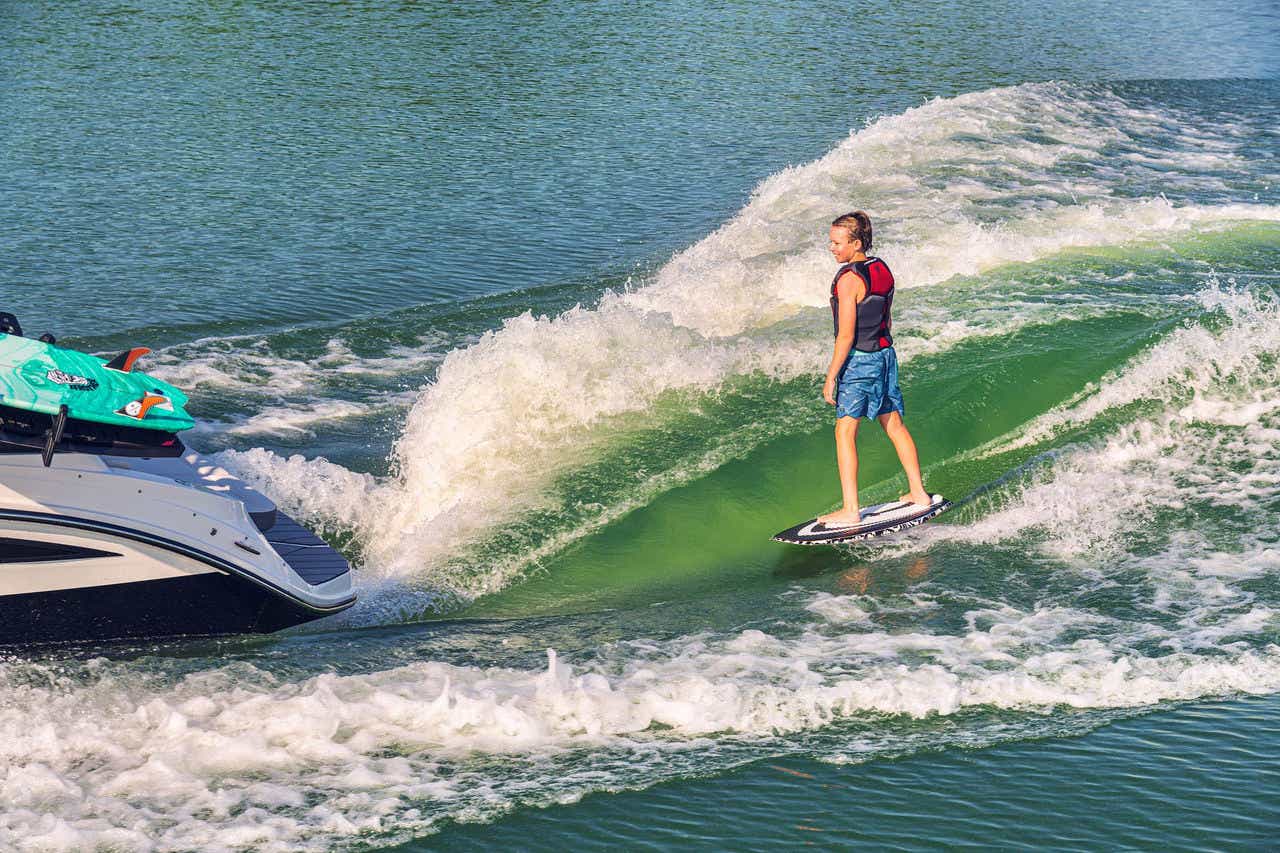
A surf wave has to do more than look tall from the swim platform. It needs enough usable pocket and push for the rider to set the rope aside and stay in the wave. That requirement becomes more demanding with a heavier adult rider, and it is where a crowded boat can mask a weak system.
Integrated ballast puts weight low and in repeatable locations within the hull. Surf tabs then alter the running attitude and wave shape. Forward-facing propulsion keeps the propellers under the hull rather than behind the transom, allowing the boat to create a surf wave without placing a rider near an exposed aft drive.
Systems engineered with integrated ballast tanks and automated tab control adjust hull displacement and running attitude directly from the helm. This gives an adult rider the continuous push needed to ride rope-free without relying on extra passenger weight or asking friends to shift seats.
That is why published “surfable” claims deserve a closer look. A child or lighter rider may be able to stay with a short wave that leaves a larger adult working the rope. Bring the riders who matter to your decision to the sea trial. Ask the dealer to demonstrate the factory surf preset with a normal passenger load, then have the adult rider attempt a rope-free run on both sides.
Also inspect what happens when the system is full. Integrated tanks preserve the cockpit better than loose bags, but ballast still occupies volume and adds weight to the boat. Check access to service points, ask what is included in the tested configuration and confirm the model’s capacities and available surf equipment with an authorized dealer.
The 23-to-25-Foot Hull Class Optimizes Gear Stowage, Tow Towers, and Five-Passenger Family Space
Wakeboards across the walkway, a tube underfoot and ballast equipment in day-use storage all reduce usable space aboard. Length does not solve every layout problem, but it gives designers more room to separate people, gear and surf hardware.
For many families of five, a 23-to-25-foot hull is the practical middle ground. It can offer meaningful cockpit circulation and storage without moving into the larger cruiser categories that are outside a typical surf-boat search. A 22-foot model can still fit the right crew, especially on shorter outings, but its available floor space and locker depth deserve close inspection once boards, vests, tubes and a full ballast system are aboard.
Stepping up to a 23- or 25-foot platform expands bow-to-stern floor space and compartment depth. Subfloor ballast packaging keeps weight low while preserving under-bench compartments with gas-assisted rams and deep in-floor lockers designed for skis, wakeboards and inflatable tubes. In deck boat layouts like our SDX Series, carrying the beam width all the way forward provides passengers with spacious lounging areas and dedicated storage so walkways stay clear of gear.
Use the sea trial to make the comparison real. Put your boards in the racks. Bring the tube you actually use, not a folded brochure version of it. Open every under-seat and in-floor compartment while the boat is loaded. Can a passenger move from the bow to the cockpit without stepping over gear? Does the tow tower fold or clear the storage and trailering arrangement you expect to use? Are ballast controls easy to reach from the helm seat?
Surf-Crossover Hulls Merge Multi-Sport Family Cruising With Accessible Wave Performance
Dedicated inboard towboats are built around wake creation. That focus can make sense when surfing is the central purpose of every outing. But a family that spends equal time cruising, swimming, towing a tube and crossing open water should consider how the hull behaves after the surf session ends.
Forward-facing sterndrives place counter-rotating propellers under the hull, allowing wakesurfing while retaining the versatile crossover operation of a sterndrive sport boat. In its comparison of the category, Boating Mag describes forward-drive systems as a way to create a clean surf wave while supporting versatile operation. The source predates current model offerings, so use it to understand the architecture rather than as a current equipment guide.
For buyers who value open-water comfort, a deep-V crossover hull paired with forward-facing propulsion driven by Mercury MerCruiser power supports composed cruising as well as accessible surf capability. The deeper deadrise handles lake chop with composure during family cruises, while integrated ballast and surf systems build a clean wave when you are ready to surf.
We offer surf propulsion within our lineup of premium fiberglass boats – which span from 19 to 40 feet, and include outboard, sterndrive and surf options across our SPX, SDX, SLX and Sundancer lines. That range lets you select the propulsion and layout that match your balance of watersports and family day boating.
A crossover can suit families seeking a balanced day aboard and a surf wave that works for their crew. A dedicated inboard towboat may still suit buyers whose priorities center on wake adjustability and repeated surf sets rather than cruising range, seating flow and rough-water comfort. Neither choice should be made from a wake photograph.
What if Your Lake Restricts Wake Boats?
Lake restrictions can change the purchase decision before you ever compare a ballast number. Rules may address boat type, operating speed, distance from shore, wake creation or where certain activities are permitted. A forward-drive crossover is not automatically permitted simply because it is not a conventional inboard V-drive.
Before contacting a dealer, obtain the current rules from the authority that manages your lake and marina. Ask whether the restriction applies to specific propulsion types, ballast use, wake-surf operation or all wake-enhancing systems. Then share those rules with the dealer and discuss only configurations that fit them. A boat that cannot be used as intended on your home water is not the right crossover, regardless of its layout or surf capability.
Sea-Trial the Boat You Plan to Own
The final decision should happen on the water with a configuration close to the one you will buy. Bring the people, equipment and expectations that will define your weekends.
Load the boat with a realistic crew, boards, safety gear and day-use equipment. Test the surf system with the adult rider whose ride places the greatest demand on the wave.
Ask to run the boat through the water conditions you expect to encounter, then assess helm visibility, ride comfort and passenger stability at cruising speed.
Fill and drain the integrated ballast system. Watch the controls from the helm and confirm what presets and surf equipment apply to the exact model.
Open every storage compartment with gear aboard. Check tower-rack access, in-floor locker dimensions and cockpit walking room.
Review the selected propulsion, ballast and surf equipment with an authorized Sea Ray dealer. Features and options vary by model and configuration.
The boat should leave room for the ride, the people waiting their turn and the long cruise home together.
This website does not provide financial or legal advice. The information available on this website is provided for general informational and educational purposes only and is not a substitute for professional advice. You should consult with the appropriate professionals prior to making any financial decisions. YOUR USE OR RELIANCE ON ANY OF THE INFORMATION PROVIDED HEREIN IS SOLELY AT YOUR OWN RISK. UNDER NO CIRCUMSTANCE SHALL WE HAVE ANY LIABILITY TO YOU FOR ANY LOSS OR DAMAGE OF ANY KIND INCURRED AS A RESULT OF THE USE OR RELIANCE ON ANY INFORMATION PROVIDED.
Options and features mentioned subject to change. Please confirm availability of all accessories and equipment with an authorized Sea Ray dealer.